
Grant writing & proposal development · Loganville, GA

Alumi

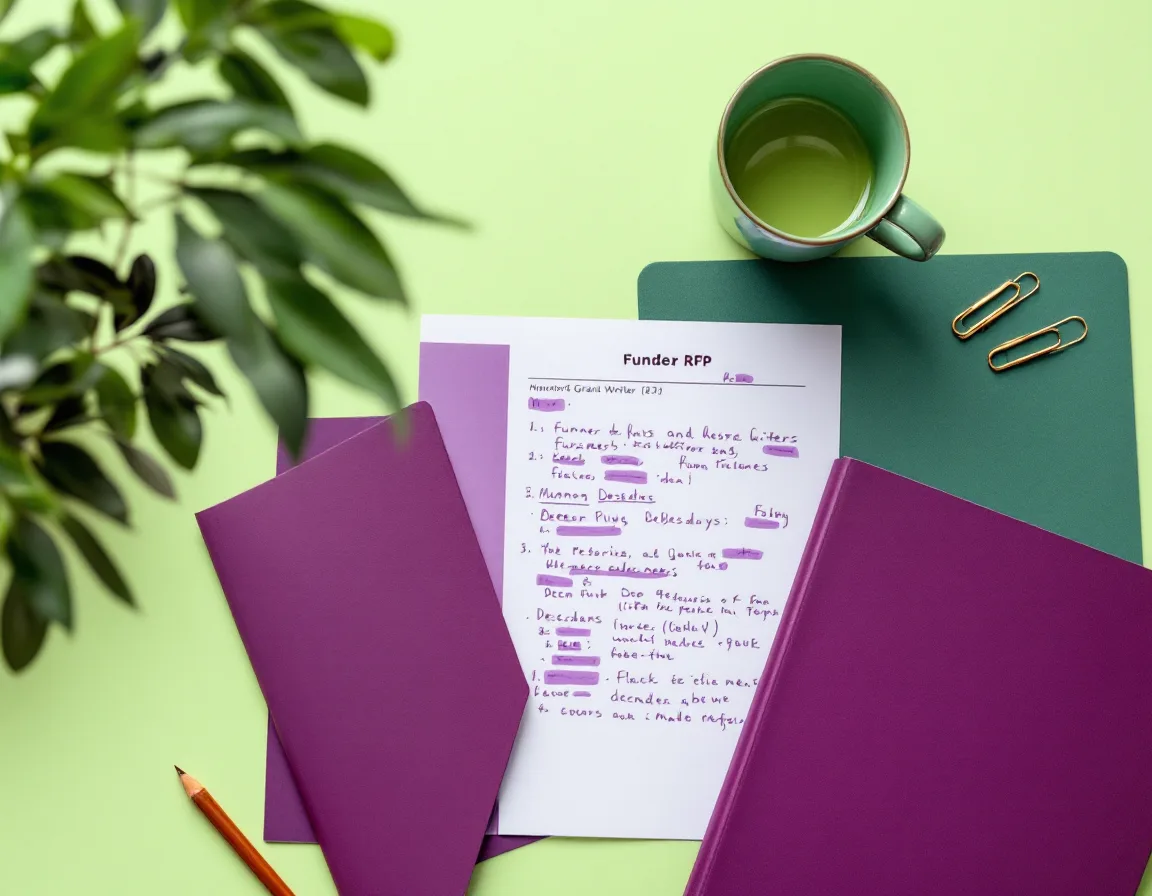
A grant writer's desk with an annotated funder application, a plum folder and a green mug

Funder research, full grant applications and reusable proposal libraries for small nonprofits. One flat fee per submitted application: $385 for a letter of inquiry, $1,480 for a full application.

Phones answered Mon–Fri 10am–4pm.

What you get, in order

Six milestones between the intake call and the submit button

A single full application runs 17 business days from intake, scheduled backward from the funder’s deadline. Each milestone ends with a file in your inbox, not a status update.

  1. 1Day 0

    Intake

    A 45-minute call. We pull your latest 990, current budget and program outcomes.

  2. 2Day 3

    Fit memo

    One page ranking 3–5 funders by median award, geography, eligible budget and deadline.

  3. 3Day 5

    Ask & outline

    The ask amount, budget skeleton and logic model, signed off by you before drafting.

  4. 4Day 12

    Full draft

    Narrative inside the portal’s character limits, plus the budget justification.

  5. 5Day 15

    Edit pass

    One consolidated round of your comments, returned as tracked changes.

  6. 6Day 17

    Submission pack

    Final PDF, portal-ready text, attachments checklist; answers filed to your library.

Deadline inside 17 days? Say so on the first call and we’ll compress the edit window, not the funder research.

Start the clock
  • Statement of need
  • Logic model drawn to the funder’s template
  • Budget and budget justification
  • Character counts checked against the portal
  • Letters of inquiry
  • Attachments checklist: IRS determination letter, 990, board list
  • One-page funder fit memo
  • Evaluation plan with named indicators
  • Boilerplate library, indexed by section
Our approach

Read the guidelines as a spec. Edit the draft as a reviewer would.

Small nonprofits lose awards on mismatch, not on mission: wrong funder, wrong ask, a narrative that ignores the rubric. We fix those three before a sentence gets written.

  1. 01Funder fit first
  2. 02Rubric-mapped narrative
  3. 03Budget agrees to the dollar
  4. 04Drafted once, filed for reuse
  5. 05Limits we draft to
  6. 06Questions, answered
Hands marking a printed budget page with a red pencil next to a laptop
01

Funder fit before the first sentence

The fit memo scores each funder on four fields: median award size, geographic restriction, eligible organization budget, and deadline cadence. An application to a funder whose median award is $5,000 never asks for $50,000.


02

Every paragraph answers a scoring criterion

We map the narrative to the funder’s rubric, section by section, so a reviewer holding a score sheet finds each point in the order the sheet lists it. Where the funder publishes no rubric, we build one from the guidelines and the last funded cycle.

03

The budget and the narrative agree to the dollar

Every figure in the narrative is traced to a budget line, and every budget line to a sentence of justification. Personnel percentages, indirect rate and match are reconciled in one pass before the draft leaves our desk.

04

Drafted once, filed for reuse

Each submitted answer (mission, need, outcomes, evaluation) goes into your library with its character count and the funder it went to. The next application starts from filed text, not a blank page.

Spec sheet

Typical portal limits we draft to

  • Statement of need≈ 3,000 charactersLocal data, named population, one cited source per claim.
  • Project narrative2–5 pagesActivities, timeline and outcomes in rubric order.
  • Logic model1 pageInputs → activities → outputs → outcomes, one indicator each.
  • Budget justification1–2 pagesLine-by-line, with the match shown separately.
  • Attachmentsper funderIRS determination letter, latest 990, board list, financials.
Volunteers unloading produce crates at a small community pantry

Questions a board treasurer asks first

Do you guarantee funding?

No. Nobody can, and we never bill as a percentage of an award. You pay a flat fee per submitted application, so our incentive is a clean, well-fitted file, not an inflated ask.

Is $1,480 worth it for a $10,000 ask?

Often not. Under about $5,000 we’ll steer you to the $385 letter of inquiry or the $240 edit-only pass. We’d rather say so on the call than bill you for a mismatch.

Who submits the application?

You do, from your own portal login. We deliver portal-ready text and a final PDF, and we stay on the phone while you paste it in.

What falls outside the flat fee?

Award reporting, site visits and funder relationship calls. Rework past the one consolidated edit round is $95 per hour, quoted before it starts.

Who owns the proposal library?

You do. It’s delivered as a shared document you keep, whether or not you hire us again.

Fee schedule

Priced per submitted application, in dollars, on this page

Half to start, half on submission. Check, ACH or card.

Short form

Letter of inquiry

$385per submitted LOI
  • Two pages maximum, written to the funder’s prompt
  • Fit memo for that one funder
  • One edit round
Reserve a slot
Most picked

Full application

$1,480per submitted application
  • Narrative, budget, budget justification, logic model
  • Attachments checklist and final PDF
  • Fit memo and one consolidated edit round
Reserve a slot
Multi-grant

Three-application package

$3,975three submissions · $465 under three singles
  • One fit memo ranks the funders; we draft all three
  • Shared sections written once and adapted per rubric
  • Scheduled across one quarter
Reserve a slot
Reusable

Proposal library build

$2,260one-time build
  • Twelve core sections written and indexed: mission, history, need, programs, evaluation, staff bios
  • Boilerplate budget with indirect rate set
  • Shared document you keep
Reserve a slot
Edit-only pass on your draft$240
Funder fit memo alone$175
Rush, deadline under 10 days+$320

Not sure which one fits? Call and we’ll size it from the guidelines.

Book a call

Bring a deadline and a funder name. We’ll scope the first application on the call.

  1. Call

    Have your EIN handy and a funder name if you’ve got one. If not, we’ll pick candidates together from your program area.

    (470) 318-7461
  2. Email the guidelines

    Send the RFP or a link, plus the deadline. You’ll get a fit verdict and a fee back by the next business day.

    info@alumicollective.com
  3. Walk in with the paperwork

    222 Evergreen Way, Loganville. Bring the printed guidelines and last year’s 990; we’ll mark them up at the table. Call first and a desk is held.

    Route to the front door
A plum desk phone beside an appointment ledger and coffee cup
Tap to call (470) 318-7461
Mon–Fri
10am–4pm
Sat–Sun
Closed
222 Evergreen Way
Loganville, GA 30052

After hours, email. Replies go out the next business morning.

Find the door on a map

House rule, taped above the desk

Contact Alumi

A reviewer reads dozens of applications in a sitting. Ours answer the guideline in the order it asks.
— Alumi’s editing rule, 222 Evergreen Way

Send the guidelines, the deadline and one sentence on your program

We reply with a fit verdict and a flat fee. Prefer the phone? (470) 318-7461, Mon–Fri 10am–4pm.

Call now Email us